Review > Vigilante (DC Universe Classics)

The Vigilante was originally a Western hero, whose 1941 debut came in Action Comics–the same title whose first issue had introduced Superman three years earlier. He was popular enough at one point in the late 1940s to inspire a series of film serials, and his popularity continued for a while after the Golden Age of superheroes came to a close (the Western genre was huge in the 1950s and 1960s, something we of the younger set may not realize).

In the 1980s, Marv Wolfman and George Perez revived and updated the character in the pages of their mega-popular New Teen Titans. Now a disillusioned New York district attorney named Adrian Chase who decides to take justice into his own hands, the Vigilante was basically DC’s answer to Marvel Comics’s Punisher, with shades of Daredevil thrown in (Marvel would later return the favor by ripping off Wolfman and Perez’s Deathstroke in the form of Deadpool).

Initially, the Vigilante took pains not to kill his victims, but with a few years he was almost as brutal as the Punisher. His solo series was very dark, even for the time, with one particularly memorable storyline by Alan Moore featuring murder, prostitution, drug use, child molestation, and one very nasty death-by-tire. As time went on Chase became increasingly unhinged, even killing police officers who got in his way. In issue #50, weighed down by guilt, Chase shot himself. Brutal, yes, but probably a more believable end for this sort of personality than the Punisher’s endless war.

Given his grim, unheroic end, the Adrian Chase version of the Vigilante has been largely forgotten in DCU lore, though the Vigilante name and M.O. has been resurrected several times (most recently in the pages of Nightwing and Teen Titans). Chase has certainly never been honored with an action figure by Hasbro or DC Direct, though Kenner had planned one for the Super Powers line in the mid-’80s before the line was canceled (and before Chase offed himself).

But now, Mattel and the Four Horsemen have given us a fine version of the late, tragic Mr. Chase. With him in your hand, perhaps you can weave a new ending for his story–one filled with blazing guns, heroic gestures, and not nearly as much murder and suicide. But the lesson here is clear: don’t be a district attorney in the DC Universe. You’ll end up murderous, psychotic, disfigured and probably dead. Get out while you can, Kate Spencer! (more…)

Review > Commander Steel (DC Universe Classics)

Due to the heavy re-use of body parts in DCUC, you occasionally get a really boring figure. Wave 5’s Atom, while an important character, was one example. And now, we have Commander Steel.
I don’t know much about the character, and even my attempts to find out more were fairly unsuccessful. Despite his Golden Age look, he was actually created in 1978 by Gerry Conway and Don Heck. The character, Henry Heywood, served as a superhero during WWII, where he was commissioned “Commander” by Winston Churchill, of all people. Eventually, Henry was replaced by his grandson Hank, who was then killed in action. Henry then went back into costume and died himself.

Another grandson, Nathan, then took up the mantle, but because he never served in the military, he’s known as Citizen Steel, and currently serves in the Justice Society of America. Enjoy him while he lasts, folks–given the family’s track record, I’m sure Dan “Deathbringer” Didio will get to killing him at some point.

For whatever reason, Mattel and DC seem to have decided to go with the Henry Heywood I biography.

(more…)

Review > Parademon (Green) (DC Universe Classics)

I did the rundown on the history of parademons in my review of the Red Parademon, so I hope you’ll pardon me if I refer you to that article if you haven’t read it already. I could copy and paste the same information, but then I’d just look even lazier.

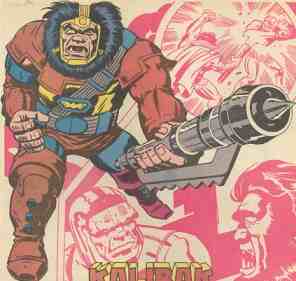
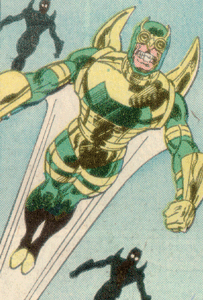
The Green Parademon variant is the one based on the original of the parademons in Kirby’s comics. In their green-and-yellow outfits and large numbers, they strongly resemble the shock troopers of Marvel’s HYDRA, who first appeared in Strange Tales #135 in 1965 and were created and designed by, yes, Jack Kirby and Stan Lee. Kirby’s parademons (as one PGPoA reader pointed out in my Red Parademon review, possibly meant as a play on “paratroopers,” which Kirby would have been familiar with from his time in the army during WWII) were created a good six years after he designed the HYDRA goons. The two share similar roles in their respective organizations and share the same fashion sense when it comes to colors and goggles. But then, Kirby wasn’t above cribbing from previous designs on occasion–see Blastaar (Marvel, 1967) and Kalibak (DC, 1971). One wonders whether Kirby simply wanted the opportunity to use the characters he’d created his own way, rather than letting another write develop them. (more…)

Review > Parademon (Red) (DC Universe Classics)

Every dark lord needs his cannon fodder–someone to throw into the gaping jaws of death in order to fatigue, delay, or otherwise annoy his foes. Sauron has his orcs, Darth Vader has his stormtroopers, Ozzy Osbourne has his immediate family. Darkseid, Jack Kirby’s amalgam of Richard Nixon and Jack Palance who now serves as the DC Universe’s darkest lord, has his parademons.

What are parademons? Even after reading a good amount of New Gods comics, I’m not quite sure. I don’t think Kirby himself ever really got into their background much. The prefix “para-” suggests they’ve not quite graduated to being full demons. On the other hand, given Darkseid’s obsession with Anti-Life, perhaps parademons are simply the Apokoliptian equivalent of paramedics–they try to kill you rather than save you.

In the original New Gods comics, parademons were depicted as ugly gray-skinned humanoids in green-and-yellow outfits; they didn’t look anything like the classic Western conception of a demon. When Kenner and DC created the Super Powers toy line in the 1980s, they paid Kirby to redesign some of his characters (most notably the parademon and Mantis)–possibly just so he could be paid royalties for his work. Oddly enough, Kirby’s redesign of Mantis ended up looking much like the original parademon, while his new parademon looked a lot more like the classic pitchfork-bearing devil. Aside from the odd appearance in a DC comic (parademons are almost always depicted based on Kirby’s original green version), the only media this version of the parademon appeared in was the final season of the Super Friends cartoon.

Since the Four Horsemen and the designers and brand managers at Mattel are such fans of the original Super Powers line–and Kirby–it’s no surprise we got both the classic green parademon as well as this one. They’re available in equal 50/50 case ratios, although the comic-accurate green version is more popular with collectors. (more…)

Review > Mr. Terrific (DC Universe Classics)

The eighth wave of DC Universe Classics is heavy on members of (or foes of) the Justice Society of America. For those who may not know, the JSA is the older sibling of the better-known Justice League of America, having been created in the Golden Age of superheroes. Composed of the original versions of DC heroes such as Hawkman, Doctor Fate, Hourman, the Spectre, the Atom, Green Lantern and the Flash, the JSA and its Golden Age members would later make sporadic appearances in Justice League of America during the Silver Age.

In the late 1990s, the JSA was brought back as a regular series by super hero screenwriter extraordinaire David Goyer (Dark City, the Blade films) and James Robinson, and later, an up-and-comer named Geoff Johns. While the JLA dealt primarily with threats to the world, the JSA’s ostensible mission was helping to teach the next generation of superheroes. One of the heroes who would become integral to the JSA was Mr. Terrific, another modern-day reinvention of a Golden Age character. It’s a testament to the writers that a character with such a goofy name can become one of the most compelling superheroes of recent years (even rating a high-profile role in Justice League Unlimited‘s final season). (more…)

Review > Gentleman Ghost (DC Universe Classics)

Last year, an extremely obscure Batman villain, Killer Moth, not only got his own DCUC figure but also appeared in the bestselling videogame Lego Batman. If 2008 was the Year of Killer Moth, 2009 appears to be the Year of Gentleman Ghost.

While the relatively obscure villain made a few brief appearances on Justice League Unlimited, he’s had starring roles in two Batman: Brave and the Bold episodes–including a memorable origin episode, “Trials of the Demon,” which also features Etrigan and Batman in his Gotham by Gaslight get-up.

And now Gentleman Ghost receives his very own DCUC figure, featuring a brand-new body sculpt. It’s already known this sculpt will be re-used for the Joker later this year, and I think it’s a good bet we’ll see similarly-dressed characters such as Uncle Sam and Ra’s Al Ghul in the near future. (more…)

Review > Hawkgirl (DC Universe Classics)

While sidekicks have been around almost as long as superheroes, the trope of a female version of a male superhero, while common today (hi, X-23), was more rare during the Golden Age of comics.

While many female versions of male superheroes often come off like cheap gimmicks, there are some cases where they work out quite well. Such a one is Hawkgirl, whose alter ego, Shiera Saunders, was introduced in the same 1940 comic as Hawkman and became his high-flying partner a year later.

Shiera (later renamed Shayera in the Silver Age) was neither a sidekick nor a simple female version of Hawkman. She was his lover (later wife) and a full partner in his adventures, and her popularity has often rivaled or even eclipsed that of her significant other, particularly when Hawkgirl was made into a founding member of the animated Justice League.

Like Hawkman, Hawkgirl’s continuity is a mess. I won’t even try to summarize it, but suffice to say the current Hawkgirl’s real name is Kendra Saunders. The current status of Hawkman and Hawkgirl in the DC Universe–including their identities–is something of an ongoing question. This figure is unquestionably based on Shayera Hol, the Silver Age Hawkgirl, but the packaging bio is taken from the current Kendra Saunders Hawkgirl. (more…)

Review > Dr. Fate (Classic variant) (DC Universe Classics)

Like many of  DC Comics‘ most iconic characters, Doctor Fate was created during the Golden Age of comics way back in 1940, in More Fun Comics #55. He was somewhat unusual for the time in that his powers came from magic, not (largely misrepresented) science, and he wore a helmet that covered his entire face. After a moderately successful four-year run, Doctor Fate and his alter ego, Dr. Kent Nelson, faded into obscurity until they were revived in the 1960s for the occasional guest appearance with the Justice Society of America in the pages of Justice League of America.

For DC Universe Classics, the Four Horsemen created two variants. The first is the subject of this review–the classic Fate, depicted in the bright Golden Age yellow and blue, which he also sported in his Super Powers incarnation. There’s also a gold “Hector Hall” variant, which features a more detailed livery collar and gold paint on the collar and helmet, torso, and boots (though not the gloves or cape). I think the helmets are the same sculpt, but not owning the Fate variant, I’m not certain–feel free to let me know otherwise in the comments. (more…)

Movie Review > Star Trek

1139413_height370_width560

I’m a second-generation Star Trek nerd. There exists a photo–I’ve got to ask my mom to dig it up, so I can scan it and post it here–of my dad and a bunch of his college friends in full classic Trek uniforms. This past Christmas, I gave him the Diamond Select replica communicator & phaser set, and I’m pretty sure I’ve never given him a gift he liked that much before. Ever.

Which explains why, in 1987, my dad was watching a new show called Star Trek: The Next Generation when his eight-year-old son wandered in. Catching sight of a man in a colorful uniform with some sort of strange robotic visor, who was in shock at the discovery of a frozen corpse, the son sat down and began a lifelong love affair with that which Gene Roddenberry had wrought. (more…)

Review > City Display (Action Figure Displays)

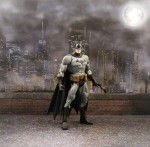
The folks at Action Figure Displays are still hard at work creating some of the coolest backdrops for your action figures, and they’ve made some improvements on the original design (see my review of the Alley set here). The displays are now 10 ½” tall, which is 2 ½” taller than before.

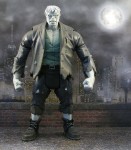
JDP was kind enough to send along another sample, this time of the City backdrop. The new dimensions are 13.5″W x 10.5″H x 7.75″D, and as you can see, even a giant BAF like Solomon Grundy can now stand comfortably beneath the top of the display.

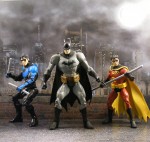
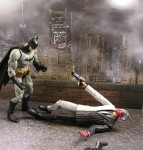
The City display has a great Gotham look to it, complete with a misty full moon and cloud-shrouded skyscrapers. What impresses me most, though, is the way the top of the brick wall offers a fantastic 3D effect (it’s most evident in the Two-Face shot).

As Dr. Mrs. Ghostal noted to me, the City set is tailor-made for the likes of Batman and his allies, although the Teenage Mutant Ninja Turtles and any other rooftop-loving characters (Neo from The Matrix, the Tick, etc.) would work great as well.

As much as I loved the Alley set, I have to say the City set is even better. And the added height for the same price as the original versions make for a greater value.

What’s more, JDP will soon be offering peg stands to help those wobbly figures stand better. They’ve also added a number of new designs and are looking to add many more in the near future (I particularly like the look of the Jungle base).

With a great product and a committment to improvement in both design and value, JDP is quickly becoming a major player in the action figure accessory market.