Review > Clash in the Cosmos (DC Universe Classics)

Despite being the archetypal superhero, Superman has a surprisingly limited rogues’ gallery. However, he does have a few heavies aside from Lex Luthor, and arguably the #2 Super-baddie is Brainiac.

We had a version of Brainiac in DC Super Heroes, based on the short-lived robot version that, despite is brief time in the comics, managed to inspire a much-loved Super Powers figure. To the best of my knowledge, the Silver Age version of Brainiac has never had an action figure until this year–suddenly he’s getting one in both DC Direct’s upcoming History of the DC Universe and here in Mattel’s DC Universe Classics “Clash in the Cosmos” two-pack.

To be fair, it’s not all that hard to see why the Silver Age Brainiac has had a hard time getting made–he’s absolutely, 100% goofy-looking. The electric pink shirt, the white polo shirt collar, the black shorts and knee socks…seriously, what was artist Al Plastino thinking when he designed this guy? I think he probably looked ridiculous even in 1958; by the late 1970s, his design was flat-out ludicrous.

However, that hasn’t stopped good writers from making Brainiac a force to be reckoned with, from his appearances as a major big bad on Justice League Unlimited to his recent retcon/reboot at the hands of Geoff Johns.

Oh, and there’s a Superman figure, too. (more…)
Review > Ultraman and Alexander Luthor (DC Universe Classics)

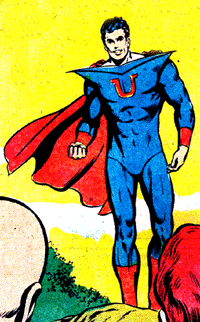
In the 1960s, as DC Comics developed their revamped Silver Age world of superheroes, they found themselves in a quandary–how could they explain all those earlier adventures of Batman, Superman and other heroes while maintaining the integrity of the new Silver Age stories? Thus was born the DC Multiverse, in which the Golden Age adventures now took place on “Earth-2” while the Silver Age took place in the contemporary “Earth-1.” Once this concept had been introduced, writers immediately began to play with it, introducing other Earths such as Earth-3, a world where Superman is evil and Lex Luthor is good.

Alexander Luthor was an acclaimed scientist on his homeworld of Earth-3, one of many “alternate universes,” where history often played out in opposite versions of the Earth we know. When two of his counterparts from Earth-1 & Earth-2 set their sights on conquering his Earth, Alexander enlisted the aid of the evil Luthors’ respective archenemies, the Supermen of their world, to come to [sic] and help fend off the attack. In response, the evil Luthors partnered with Earth-3’s twisted version of Superman, the evil Ultraman, to back their cause.

Born on the planet Krypton of an alternate universe where good and evil are reversed, Ultraman quickly became the most powerful super-criminal of that planet. A mirror-image of Superman, Ultraman had all the powers and abilities of Kal-El, only with the desire to use them for evil. He joined with other super-criminals to form the Crime Syndicate of America, the evil opposite force of the Justice League. Ultraman’s primary opposition came from Alexander Luthor, Sr., a genius scientist devoted to bettering humanity through his inventions.

(more…)

Review > Hordak (Masters of the Universe Classics)

By 1985, the original Masters of the Universe line was three years old–a pretty long time for a boys’ action figure brand, if not that impressive next to its big sister Barbie. The He-Man cartoon was at its peak and She-Ra was just about to hit. While He-Man and his arch-nemesis Skeletor had already become cultural icons, Mattel decided the skull-headed necromancer might be getting a little long in the tooth. It was time to up the ante against He-Man and his allies–it was time for the Evil Horde.

While Skeletor and his minions were all based on the same two or three body types, Hordak and his Evil Horde benefited heavily from MOTU’s success: all five of the original 1985 Evil Horde figures received brand-new tooling (and except for Hordak, they were all entirely new sculpts). What’s more, the ancillary fiction (the mini-comics and, later, the She-Ra cartoon) established Hordak not only as being more powerful than Skeletor, but as having been Skeletor’s master (or at least mentor) at one point.

Masters of the Universe Classics Hordak arrives as one of the most anticipated figures in the line yet. While he received an impressive “staction” from the Four Horsemen and NECA, this represents the first new Hordak action figure in twenty-four years.

(more…)

Book Review > “Mastering the Universe” by Roger Sweet & David Wecker

mastering-the-universe

Mastering the Universe: He-Man and the Rise and Fall of a Billion-Dollar Idea (Order from Amazon)
by Roger Sweet and David Wecker
Emmis Books, 2005
ISBN: 1578602238

I picked up a copy of Mastering the Universe when it was first published. Aside from flipping through a few bits here and there, I never sat down and read the whole thing through until a few weeks ago. The book is ostensibly an account of the creation, development, and ultimate fall of Mattel’s Masters of the Universe toyline through the eyes of toy designer Roger Sweet.

But if you take away anything from Mastering the Universe, Sweet would like it to be this: it was all his idea. And I mean all. As one reviewer of the book on Amazon put it, it reads like a court deposition in a case where the question is who created He-Man. Sweet backs up his claims by constantly citing specific patents, internal documents, and other paperwork that means little or nothing to the average reader (or indeed, anyone other than another Mattel employee).

For this reason, Mastering the Universe isn’t always an easy read. Sweet’s writing (aided by his nephew, David Wecker) is peppered with moments of bitterness, egotism, and defensiveness, not to mention a heavy helping of self-martyrdom. Oddly enough, in both its self-aggrandizing nature and its defensiveness regarding credit for MOTU, Sweet’s book shares certain similarities with Dream Doll, the autobiography of Mattel founder Ruth Handler, who claimed she was the sole inventor of Barbie. (more…)

TRU Heroes

dscf0005

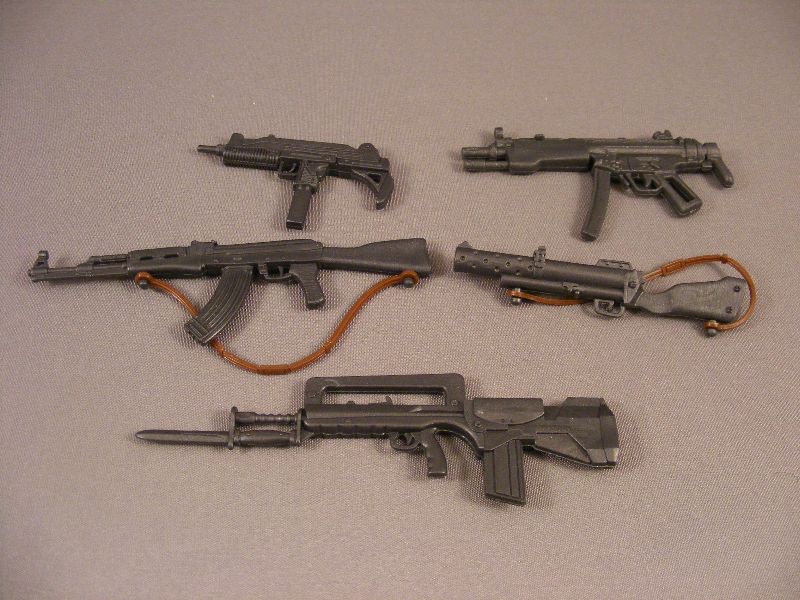
This weekend I came across something interesting at TRU. I’m a sucker for guns that fit 6″-scale figures, and I’m always on the lookout for more. I bought a Cannon Spike Cammy just for her Uzi, Walther PPK and Skorpion–and also the knife, which I gave to Movie Masters Joker.

A year or so ago, I came across a line of cheap G.I. Joe knock-off figures at my local pharmacy. While they were only 4″ tall, their weapons are clearly made for 6″-scale figure–one rifle is longer than the figures. While the guns have no paint applications, they’re molded in gunmetal gray, have surprisingly detailed sculpting, and unlike most DCUC weapons, they’re made from stiff plastic. You can see Deathstroke holding the shotgun (maybe a Franchi SPAS-12?) in this shot, and the rifle (which I think is based on a PSG1, but the toymakers added a banana clip it probably can’t actually use) in these shots of a Plan-B Emergency Forces SWAT figure.

Anyway, this weekend I came across a set of these figures under the name “True Heroes.” The back of the package says they’re designed and produced by Toys ‘R Us themselves, which seems odd since they’re the exact same figures available at my pharmacy. Presumably both companies are just buying a generic figure line from some Chinese company (Chap Mei, perhaps?) and using it as a store brand. TRU had both the two-packs I’d seen at the pharmacy (for $3 each) and six-packs for $8. While one pack had all the guns I’d already bought (the rifle, shotgun, and Mp5K), the other one had a plethora of guns I’d never even seen before, including an Uzi that’s even more accurately sculpted than the one that came with Cammy. (more…)

Comic Review > Batman and Robin #1

11864_400x600

I got on board Grant Morrison’s run on Batman just a month or two before the “Batman R.I.P.” storyline began. I was so fascinated (and sometimes frustrated) with what I read that I went back and bought every issue he’d written since #655.

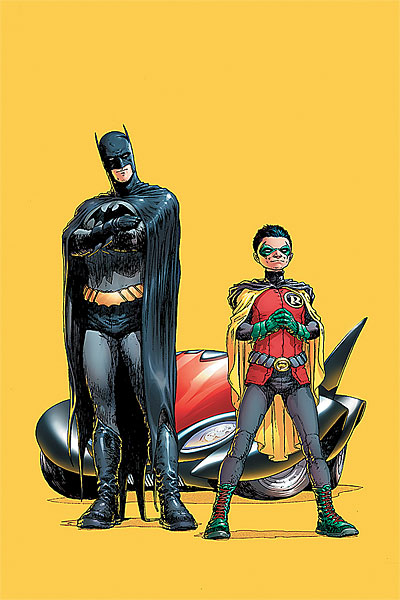
After a brief interval taken up by the bombastic and exceedingly anticlimactic “Battle for the Cowl,” Morrison is back to writing the Caped Crusader. But this time, it’s Dick Grayson as the Dark Knight, and Morrison’s own controversial creation, Damian Wayne–the son of Bruce Wayne and Talia Al Ghul–as Robin.

I’ll admit I’m one of those people who think you really can’t replace Bruce Wayne. That particular superhero/secret identity dyad is too iconic, like Clark Kent and Superman. At one time, fans might have pointed to Wally West’s Flash or Kyle Rayner’s Green Lantern as evidence that this “legacy” idea can work, but–aside from the fact that Barry Allen and Hal Jordan are back anyway–both of those heroes had their own predecessors in the Golden Age. Unlike them, Bruce Wayne has been Batman since before the very first Flash or Green Lantern appeared in comics. The time to replace Batman was the early Silver Age, before the 1960s TV show cemented Batman and stately Wayne Manor as American cultural icons.

What’s more, it’s largely Morrison’s own fault it’s hard to accept anyone else as Batman now. It was Morrison who created the “Bat-god” in the pages of JLA, and this characterization was carried into the Justice League Unlimited cartoon. As Morrison has suggested in interviews, “Batman R.I.P.” was essentially a mediation on that idea.

The upshot of all this is: enjoy the ride while it lasts, because chances are Bruce will be back in the cowl within a year or two. With that in mind, Batman and Robin is shaping up to be a fun–and profoundly weird–ride. (more…)

Review > T-800 Pescadero Escape (Terminator 2: Judgment Day)

I’m willing to argue with anyone that Terminator 2: Judgment Day was the high water mark of Arnold Schwarzenegger’s film career. Between his performance as the cybernetic villain in the first film and the 1991 sequel, he’d become an international superstar with a string of hits including Commando, Predator, Twins, and Total Recall. After T2, Schwarzenegger would veer between serviceable action flicks (True Lies, Eraser, Terminator 3) and bombs (Last Action Hero, Batman & Robin) before giving up acting for the lesser stress of governing the world’s fifth-largest economy. But none of the post-T2 films came close to matching that same mixture of action, storytelling, and good old fun.

Now, as they have so many times before, NECA has answered my prayers–this time for a true Terminator 2 figure, complete with an Arnold likeness worthy of, dare I say it, Hot Toys themselves. According to the packaging, there are five figures in the line (though I’m not sure they’re all out yet): an Endoskeleton, the “Man or Machine” model with the stripped-off cybernetic arm, the demolished “Final Battle” T-800, the “Cyberdyne Showdown” T-800 carrying the minigun, and the subject of this review, the “Pescadero Escape” T-800. I chose this one for the simple reason that he’s the basic, iconic Terminator. (more…)

Review > Zodac (Masters of the Universe Classics)

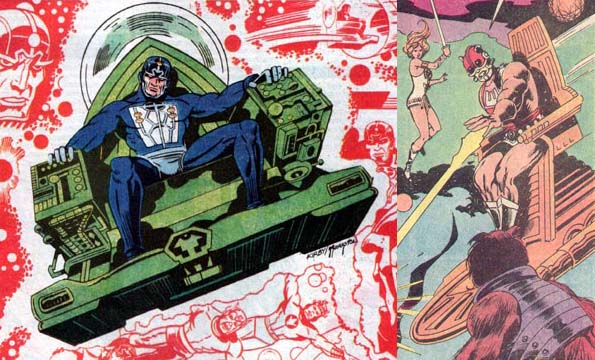
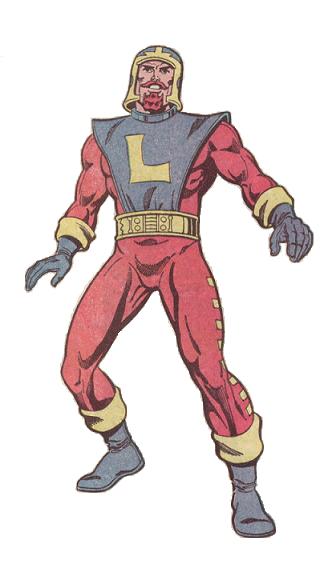
Since first reading about the idea (I can’t remember where) that the Masters of the Universe premise was similar to Jack Kirby’s New Gods, it’s become fun to try and equate various characters. Darkseid is Skeletor, of course; Kalibak is Beast Man; He-Man is Orion; Teela is Big Barda; the Sorceress and King Randor share the duties of the Highfather; Stratos is Lightray; Man-at-Arms is Himon; Granny Goodness is Evil-lyn, and so on. Obviously some of the comparisons work better than others, but none are quite so similar as Zodac and Metron. Both were depicted as cosmic observers who followed the battles between good and evil and occasionally interceded (usually on the side of good). And they both were fond of flying space chairs.
While his original packaging described him as an “Evil Cosmic Enforcer,” most of the 1980s MOTU fiction established Zodac as a “neutral” character, someone who observed the battle between good and evil from a cosmic perspective. What exactly Zodac’s role in these events was a lot less clear. There seem to be a few different types of “neutral cosmic observers.” There’s Metron himself, who seems content to observe from afar but occasionally interferes–usually by helping the good guys. Then there’s Marvel’s Watcher, who’s actually sworn not to interfere but does so anyway, all the time, always by helping the good guys.

Zodac’s a bit more complicated, since he is usually described as a Cosmic Enforcer, suggesting it’s his job to make sure good and evil–or perhaps more logically, order and chaos–are in balance, helping whichever side seems to be losing. By this logic, Zodac should spend a lot of time helping Skeletor, but I can’t think of a specific instance in which he interceded on Skeletor’s behalf. At most, he might not help He-Man as much as he could have. And since Zodac often delivered the moral at the end of cartoon episodes, he was more or less understood by kids to be a “good” character. Personally, however, I would have liked to see a MOTU story in which it turns out the mastermind behind a plot against He-Man was actually Zodac, not Skeletor…a kind of He-Man R.I.P. (more…)

Review > Giganta (DC Universe Classics)

How do you solve a problem like Giganta? For Mattel, the answer was to split her into a number of smaller parts and package her with the rest of DCUC Wave 8.

Giganta is this wave’s Build-a-Figure, or as Mattel calls it, “Collect and Connect” figure. However you want to phrase it, it means she’s a big toy.

Part of me wishes Mattel and the Horsemen had decided to go with Giganta’s cool modern outfit, but maybe we’ll get that down the line.

(more…)